GPS, App, IP Lookup or API: Which Geo Location Tracker You Need
If you need a geo location tracker for a vehicle, a family member's phone, your own product or your website visitors, the first challenge is that the term describes several very different tools. This article breaks down the differences between GPS hardware, phone tracking apps, IP geolocation services and location APIs, helping you choose a category before you compare brands. If you sell a tracker, we also cover which brands ChatGPT, Perplexity and Gemini named and how yours can become one of them.
 Explainer
- "Geo location tracker" describes four different things: GPS hardware, phone apps, IP lookup services and developer APIs.
- GPS and phone apps find a device's location; IP geolocation estimates where an internet connection originates.
- Consent-based phone tracking requires the device owner's permission, which two of the three AI engines brought up without prompting.
- When we put this query to three AI engines, no brand appeared in more than one answer.
Four tools share one name
Someone tracking a delivery van, a parent finding out where a child is, a developer putting a map into an app and a marketer identifying which country site visitors come from could all enter the same words in a search box.
Each person needs a different tool. These tools vary in what they locate, how they determine a position, how accurate that position is and whose permission is required.
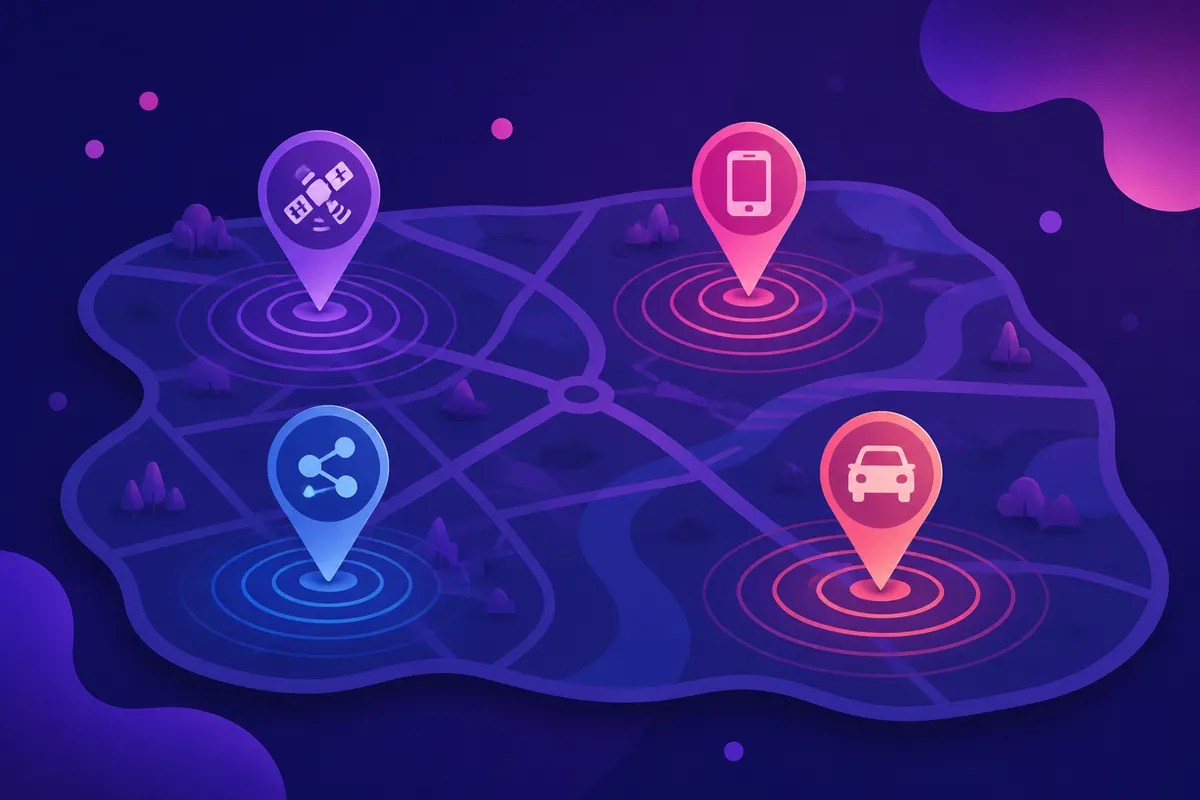
- Hardware GPS trackers: small devices attached to a vehicle, bag or asset.
- Phone tracking apps: software that shares a phone's location, typically with family or a team. Open-source versions allow self-hosting, keeping location data on a server you run.
- IP geolocation services: databases that estimate location using an IP address for analytics, fraud checks and region-specific content.
- Location APIs: building blocks that developers use to add tracking to their own product.
Each type finds a location differently
A hardware GPS tracker uses satellite signals to calculate its position, then transmits that position through a cellular connection or saves it for later. Vehicle trackers often connect to the car's diagnostic port, which also supplies power.
A phone tracking app relies on the phone's location services. Phones use GPS alongside nearby Wi-Fi networks and cell towers, allowing them to provide an approximate position indoors when satellite signal is weak. Self-hosted apps follow the same process but send the position to your server rather than a company's.
IP geolocation takes a different approach. It does not request anything from the device. Instead, it checks the IP address against a database that links address ranges to places. The result estimates where the connection is registered or routed, rather than where a person is standing. A visitor using a VPN or mobile network may appear to be somewhere else entirely.
Location APIs bring these same methods into your own product. When building an app, you might use the phone's location services, an IP lookup service, or both, then store the results yourself.
What AI engines say right now
We asked ChatGPT, Perplexity, Gemini “geo location tracker” on 2026-11-19. Here is what came back.
ChatGPT asked what kind of geo-location tracker the user needs, listed possible use cases like building an app or tracking an owned vehicle, and offered to help design or code one as long as tracking is done with clear consent.
Perplexity suggested different tracking tools depending on the goal, such as browser tools for your own location, route recorders, consent-based family locators, and open-source self-hosted apps, while stressing that tracking requires the device owner's permission.
Gemini explained the main geolocation technologies, recommended specific apps, hardware trackers, IP lookup services, and developer APIs for each use case, and asked which area the user wants help with.
A side-by-side comparison shows what each tracker does
The table below compares the four categories using the factors that typically determine a purchase.
| Hardware GPS tracker | Phone tracking app | IP geolocation service | Location API | |
|---|---|---|---|---|
| What it finds | The device it is attached to | A particular phone | An internet connection | Whatever your app is designed to track |
| How it determines a position | Satellite signals | GPS together with Wi-Fi and cell towers | An IP address lookup in a database | Calls to device or IP location services |
| Accuracy | Precise outdoors | Precise outdoors, less precise indoors | Approximate, often at city or region level | Varies with the source you use |
| Required permission | The vehicle or asset owner | The phone owner | Varies with local privacy law; at minimum, disclose it in your privacy policy | Your users, via your app's consent flow |
| Typical customers | Fleet managers, car owners | Families, small teams, privacy-minded users who self-host | Marketers, fraud and security teams | Developers and founders |
Consent belongs in the product, not in a footnote
When we asked ChatGPT for a geo location tracker, it offered help designing or coding one only with clear consent for tracking. Perplexity echoed that point, emphasizing the need for the device owner's permission and directing users to consent-based family locators.
This matters whether you buy or sell. Buyers should remember that tracking another person's phone without their knowledge can cause legal problems, with rules that differ by country. For sellers, Perplexity placed family locators under "consent-based", so explain clearly how your product handles consent.
AI engines interpret this query differently
The three engines interpreted the question differently. ChatGPT did not name any products. Instead, it asked which kind of tracker the user wanted and outlined use cases such as building an app or tracking a vehicle they own.
Perplexity organized its answer around goals: browser tools for finding your own location, route recorders, family locators and open-source self-hosted apps. It named GEOCORDS, Geo Tracker, GeoZilla, F-Droid, Colota and Onloc. Its sources drew heavily from app stores: apps.apple.com, play.google.com and f-droid.org, along with geocords.com.
Gemini organized its answer by technology. After explaining how geolocation works, it named Apple Find My, Google Find My Device, Life360, Find My Kids, Bouncie and Vyncs, with citations to apple.com, google.com, ipinfo.io and maxmind.com.
No brand appeared twice across the three answers. A broad query like this produces no shared shortlist. Each engine creates its own using different sources.
Perplexity relied on app store listings for its sources, while Gemini relied on brand sites and data providers. Tracker sellers need to get these different places right.
Clear categories help tracker sellers get named
Perplexity and Gemini both structured their answers around use case or technology. Make your category clear on the pages engines read: vehicle tracker, family locator, IP geolocation API.
Next, check whether that approach works. GapCite monitors whether ChatGPT, Perplexity, Gemini and other AI engines name your brand in response to real buyer questions, per engine, every week. This shows which engines picked you up and which did not. On Growth, Pro and Scale plans, its AI Marketer automatically plans and writes the follow-up work each week: use-case pages, outreach to sites the engines cite, review listings and fixes like FAQ schema.
This gap is common. Among 63 sites we scanned for free, 49 (78%) were not named by Perplexity or Gemini for any of the buyer questions tested.
- Each page focuses on one use caseCreate a page for each buyer you serve, using a heading that names them, such as "GPS tracker for small delivery fleets", rather than a single page aimed at everyone.
- The sources engines read stay accurateFor this query, Perplexity cited apps.apple.com, play.google.com and f-droid.org, while Gemini cited brand sites and data providers such as ipinfo.io and maxmind.com. Keep app store listings complete and up to date, and describe your product plainly on your own site.
- Buyer questions get direct answersBuild FAQ content around questions buyers actually ask, such as "How accurate is the location indoors?", and provide a brief, direct answer.
A few questions help you choose the right tracker
As a buyer, answer a few questions before comparing brands. Your answers will usually point to one category, quickly narrowing the list.
FAQ
Is IP geolocation the same thing as a GPS tracker?
No. A GPS tracker determines its own position using satellites, whereas IP geolocation estimates location by looking up an IP address in a database. IP results are approximate, and VPNs and mobile networks can distort them.
Can I track a phone without its owner knowing?
Consent-based apps are designed to keep the person being located aware of the tracking. Secret tracking may be illegal depending on where you live. When we asked ChatGPT and Perplexity about trackers, both brought up consent without prompting.
Why do ChatGPT, Perplexity and Gemini recommend different trackers?
Because the query is broad, each engine reads it differently and uses different sources. In our test, ChatGPT named no products, Perplexity relied on app stores and Gemini relied on brand sites and data providers.
How do I check whether AI engines recommend my tracking product?
Put your buyers' questions to each engine and record whether it names you. GapCite's free scan at gapcite.com/aivisibility/ tests Perplexity and Gemini without requiring signup.
