GPT Chat SEO Turns Customer Questions Into Page Briefs
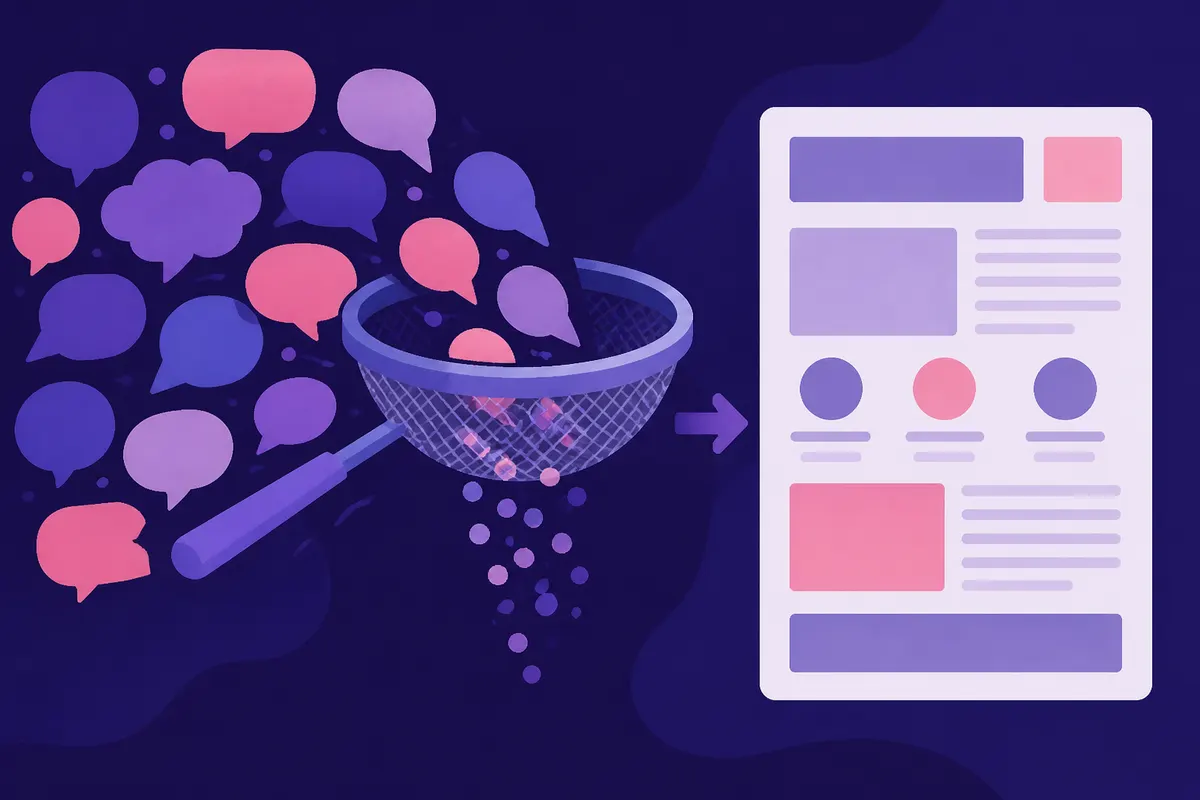
“GPT chat SEO” usually means using a conversational AI assistant for SEO tasks such as keyword grouping, content planning, metadata, and technical troubleshooting. A useful place to start is turning questions your customers actually ask into clear briefs for pages that answer them. That is different from getting your brand recommended in AI answers, although the same customer evidence can inform both.
 How to
- Start with customer language and verified product facts, not an assistant’s imagined keyword demand.
- Ask the assistant to choose between updating a page, creating one, or making no content change.
- Build briefs around the buyer’s decision rather than a broad topic.
- Route each gap to the right task: content, documentation, metadata, or outreach.
Choose the job before opening the chat
You might want help doing SEO with a chat assistant, or you might want your business to appear in AI recommendations. Start by identifying the task you need help with.
When we asked ChatGPT, Perplexity and Gemini this question, ChatGPT asked whether the goal was AI-assisted SEO, visibility in AI search, building an SEO chatbot, or an SEO service strategy.
Perplexity outlined ChatGPT SEO tasks and a reusable prompt, emphasizing verified performance data and conventional SEO fundamentals. It cited x.com, serpstat.com, devendrasaini.com, and blog.hubspot.com. Those citations give you actual pages to inspect when evaluating which external sources inform an engine’s answer on this topic.
ChatGPT and Gemini listed no sources, and Gemini cautioned about data limitations while describing keyword research, content, metadata, technical SEO, and outreach. For this walkthrough, the job is narrower: find a customer question worth answering and turn it into a brief your team can execute.
Build an evidence packet from customer conversations
Start with support tickets, sales objections, internal site searches, and questions prospects ask before buying. These sources reveal language and uncertainty that a generic keyword brainstorm can miss. Remove personal information, confidential deal terms, and anything you are not authorized to share with an external assistant.
Keep the original question alongside your interpretation. “Can contractors see invoices?” is not necessarily a request for a general article about collaboration. It may be a permissions question blocking a purchase.
Add the product documentation, policy, or internal confirmation that answers the question. Include the current page URL if an answer already exists.
- Customer language: the question as asked, stripped of identifying details.
- Buyer context: the task, concern, and decision behind the question.
- Verified evidence: documentation or an accountable owner’s confirmation.
- Existing coverage: relevant pages and what they currently explain.
What AI engines say right now
We asked ChatGPT, Perplexity, Gemini “gpt chat seo” on 2026-11-03. Here is what came back.
It asks whether the goal is AI-assisted SEO, visibility in AI search, building an SEO chatbot, or an SEO service strategy before offering a practical plan.
It outlines ChatGPT SEO tasks and a reusable prompt while emphasizing verified performance data and conventional SEO fundamentals.
It explains how ChatGPT can assist with keyword research, content, metadata, technical SEO, and outreach, with sample prompts and cautions about data limitations and content quality.
Use a repeatable chat workflow to produce the brief
Give the assistant a bounded assignment. Its job is to organize evidence and propose a useful answer, not invent demand, product capabilities, or proof. Keep your source material attached to the conversation so each revision has the same factual foundation.
- Group questions by the decision they affectPaste the anonymized questions and ask: “Group these by the buyer decision behind them. Preserve the original wording. Separate questions that sound similar but require different answers.” Review the groups against your knowledge of actual customers.
- Check whether search is the right channelAsk: “Which groups could someone reasonably research before contacting us? Which belong in account support or onboarding instead?” Treat the output as a hypothesis. Perplexity named Google Search Console; use its query reports alongside customer context to judge relevance, not invented search volumes.
- Choose the destination before the formatShare relevant existing pages. Ask the assistant to recommend an update, a new page, a help article, or no content change for each question. Require a reason tied to the reader’s task, not a default recommendation to publish another blog post.
- Generate an evidence-bound briefAsk for the reader, buying concern, direct answer, supporting facts, necessary caveats, page structure, and next action. Add: “Use only the evidence included here for factual claims. Label missing information UNKNOWN. Do not invent customer results or feature behavior.”
- Test the brief against the original questionAsk: “Could a reader answer the original question without contacting sales? What ambiguity remains? Which statements lack support?” Resolve those gaps with the relevant product or policy owner, then use the brief to update or create the chosen page.
Make the brief answer a decision, not cover a topic
Consider a hypothetical software business whose prospects ask whether contractors can access projects without seeing billing information. A weak brief expands that into “the benefits of team collaboration.” A useful brief stays with the access decision.
The brief should explain the relevant roles, billing visibility, and plan restrictions using the product evidence.
This approach also gives metadata a concrete purpose. The title and description should signal the permissions question the page answers, rather than squeezing unrelated collaboration terms into limited space.
Apply the same constraint to implementation prompts: “Write a meta description using only this page’s confirmed answer.” For FAQ schema, give the assistant the visible questions and answers and ask it to represent those faithfully, without adding claims or questions absent from the page.
| Brief field | Useful instruction |
|---|---|
| Reader’s decision | Determine whether outside collaborators can work without receiving financial access. |
| Direct answer | State the verified permission behavior, including relevant limitations. |
| Evidence needed | Current role documentation and confirmation of billing visibility. |
| Page destination | Update the permissions page if it already serves this question; otherwise evaluate a dedicated explanation. |
| Next action | Help the reader check the appropriate role settings or resolve an unsupported use case. |
Route the work instead of turning every gap into an article
A missing answer can require several kinds of work. Unclear permissions may need documentation. An outdated snippet may need a meta description change. A capability your product does not offer needs an honest limitation, not a persuasive paragraph.
Third-party coverage is a separate route. If an engine cites an external page relevant to your category, inspect what that page actually covers before considering outreach. A citation identifies a source used in that answer; it does not establish that getting listed will produce a recommendation.
For teams that want execution automated, GapCite’s AI Marketer automatically plans tasks each week and writes them, including pages, outreach to sites AI engines cite, review listings, social posts, and technical fixes such as FAQ schema and meta descriptions. It is included on Growth, Pro, and Scale, not Starter.
Measure the outcome the page is meant to change
For search-focused work, check whether the updated page attracts relevant queries and helps visitors take the intended next step. Read query language alongside performance totals. More visits from an unrelated audience would not validate the brief.
For AI visibility, ask realistic buyer questions such as “Which project tools let contractors work without seeing billing?” Check each engine separately to see whether your brand appears. GapCite tracks whether engines name a brand for real buyer questions, per engine, weekly; its free scan at gapcite.com/aivisibility/ tests Perplexity and Gemini with no signup needed. Keep those results separate from search rankings and visits.
Maintain a simple change log linking each question to its page, supporting evidence, publication change, and measurement. This makes the next chat more useful: you can ask the assistant to interpret actual results instead of requesting another batch of speculative topics.
FAQ
Does GPT chat SEO mean optimizing for AI recommendations?
It can, but it often means using a chat assistant to perform SEO work. The workflow here focuses on turning customer questions into page briefs, with related prompts for metadata and FAQ schema.
Can an assistant find reliable keywords without search data?
It can suggest wording, group questions, and propose intent. Treat those suggestions as candidates, not verified evidence of demand, and validate them against customer language and your available performance data.
Should every customer question become a blog post?
No. A product page, help article, policy update, or clearer navigation may answer the question better. Choose the destination based on what the reader needs to decide or do.
What should I do when the assistant invents a product claim?
Remove the claim and return to the underlying evidence. Ask the assistant to mark unsupported details as unknown, then confirm them with the person responsible for the product or policy.
